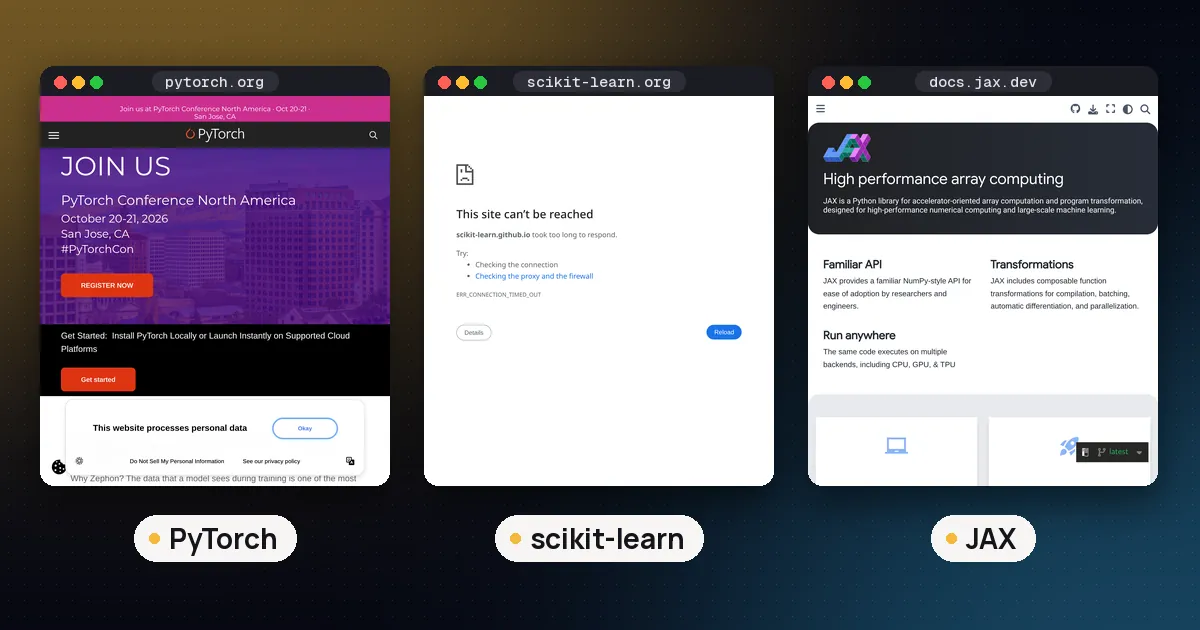
The best ML frameworks for Python in 2026 depend on what you are building. For deep learning and anything touching open weight models, pick PyTorch. For classical machine learning on spreadsheets and tabular data, start with scikit-learn, and add XGBoost or LightGBM when you need gradient boosted trees. Reach for JAX for large scale research on TPUs, Keras 3 for the shortest path to a working neural network, and MLX if your main machine is an Apple silicon Mac.
Most real projects use two of these together: one for classical models and one for deep learning. The rest of this guide explains which pair fits you.
The best ML frameworks for Python at a glance
Versions and minimum Python versions below come from each package's PyPI page, checked on October 21, 2026. They change often, so treat them as a snapshot.
| Framework | Best for | Latest version | Minimum Python | Licence |
|---|---|---|---|---|
PyTorch (torch) | Deep learning, LLMs, research | 2.14.1 | 3.10 | BSD style |
| scikit-learn | Classical ML, preprocessing, evaluation | 1.9.1 | 3.11 | BSD-3-Clause |
| JAX | Research at scale, TPUs, functional transforms | 0.12.0 | 3.12 | Apache 2.0 |
| Keras 3 | High level neural networks on any backend | 3.15.1 | 3.11 | Apache 2.0 |
| XGBoost | Gradient boosting on tabular data | 3.4.1 | 3.12 | Apache 2.0 |
| LightGBM | Fast gradient boosting on large tables | 4.7.0 | 3.10 | MIT |
| TensorFlow | Existing TF pipelines and deployment paths | 2.21.0 | 3.10 (wheels up to 3.13) | Apache 2.0 |
| Hugging Face Transformers | Pretrained models on top of PyTorch | 5.20.2 | 3.10 | Apache 2.0 |
| MLX | Training and inference on Apple silicon | 0.32.4 | 3.10 | MIT |
| PyTorch Lightning | Less training loop boilerplate | 2.6.6 | 3.10 | Apache 2.0 |
| tinygrad | Learning how frameworks work inside | 0.14.0 | 3.11 | MIT |
One practical detail hides in that table: the minimum Python version. JAX and XGBoost now need Python 3.12 or newer, while TensorFlow 2.21.0 only ships wheels for Python 3.10 to 3.13. If you want TensorFlow and JAX in one environment, Python 3.12 or 3.13 is the overlap.
How we ranked these ML frameworks
There is no single benchmark that ranks ML frameworks fairly, so this list does not invent one. Instead, each pick is judged on four things you can check yourself:
- Fit for the job. A tree boosting library and a deep learning framework solve different problems. Each pick names the job it does best.
- Ecosystem. How many tutorials, pretrained models and downstream tools assume this framework.
- Hardware support. Which GPUs, TPUs or Apple chips it can use, according to its own install docs.
- Maintenance. A recent release on PyPI and an active open source project.
1. PyTorch: best overall for deep learning
PyTorch is the default for neural networks in Python. Models are plain Python classes, execution is eager, and you can debug with ordinary print statements. The open weight model world is built on it: Hugging Face's Transformers installation guide says the library works with PyTorch and is tested on Python 3.10+ and PyTorch 2.6+. Most fine tuning tools covered in how to fine tune an LLM locally assume PyTorch too.
The PyTorch install page recommends Python 3.10 to 3.14 and offers builds for NVIDIA GPUs (CUDA) and AMD GPUs (ROCm) on Linux, plus Mac and Windows. Pick it if you are doing deep learning, research or anything LLM related. Skip it if your problem is a small table of numbers, where scikit-learn or a boosting library will be faster to get right.
2. scikit-learn: best for classical machine learning
scikit-learn is where most people should start with ML in Python. It gives you one consistent fit and predict interface across linear models, random forests, clustering, preprocessing, cross validation and metrics. That makes it the standard toolbox for tabular data and for building honest baselines.
It is deliberately not a deep learning framework. The scikit-learn FAQ says its small multilayer perceptron module only gets bug fixes and points people to TensorFlow, Keras and PyTorch for complex deep learning. GPU support is not on by default, although since 2023 a limited but growing list of estimators can run on GPUs when you pass PyTorch or CuPy arrays and turn on its array API support.
Here is a typical pattern: a scikit-learn baseline, then a boosted model through the same interface.
from sklearn.datasets import load_breast_cancer
from sklearn.model_selection import train_test_split
from sklearn.pipeline import make_pipeline
from sklearn.preprocessing import StandardScaler
from sklearn.linear_model import LogisticRegression
from xgboost import XGBClassifier

X, y = load_breast_cancer(return_X_y=True)
X_train, X_test, y_train, y_test = train_test_split(X, y, random_state=0)

baseline = make_pipeline(StandardScaler(), LogisticRegression(max_iter=1000))
baseline.fit(X_train, y_train)
print("logistic regression:", baseline.score(X_test, y_test))

boosted = XGBClassifier(n_estimators=200, tree_method="hist")
boosted.fit(X_train, y_train)
print("xgboost:", boosted.score(X_test, y_test))
We ran this on scikit-learn 1.9.1 and XGBoost 3.4.1; it prints the test accuracy of each model.
3. XGBoost and LightGBM: best for tabular data
When your data lives in rows and columns, gradient boosted trees are often the strongest model you can train, and these two libraries are the usual choices. Both offer scikit learn style classes, so they slot into the pipeline above.
- XGBoost can run training, prediction and evaluation on NVIDIA GPUs. Its GPU support page says you set the
deviceparameter tocuda, and that CUDA 12.9 or newer is required. - LightGBM, from Microsoft, describes itself in its documentation as a tree based gradient boosting framework built for speed and low memory use, with parallel, distributed and GPU learning.
Try both on your data; which wins depends on the dataset, so we will not claim one is faster in general.
4. JAX: best for research at scale and TPUs
JAX looks like NumPy but adds automatic differentiation, just in time compilation and vectorisation as composable functions. It is the natural choice on Google Cloud TPUs and popular for large research codebases. Neural network layers usually come from Flax on top of it.
Check the hardware table before committing. The JAX installation guide lists NVIDIA GPU support on Linux, TPU support on Linux, no NVIDIA GPU support on native Windows (WSL2 is experimental) and Apple GPU support as experimental. Our PyTorch vs JAX guide covers the tradeoffs in depth.
5. Keras 3: best high level API
Keras 3 is not a separate engine. It is a high level API that runs on JAX, TensorFlow or PyTorch. Per the Keras getting started page, you choose the backend with the KERAS_BACKEND environment variable, and it must be set before you import Keras. That lets you write a compact Sequential model once and switch engines later. It is a good fit for teaching, classic computer vision and small production models. See TensorFlow vs PyTorch vs Keras for how the three relate.
6. TensorFlow: best if you already run it
TensorFlow is still maintained and widely deployed, and most new TensorFlow code is written through Keras. It makes the most sense when your team already depends on TensorFlow serving or export paths. Two cautions for new projects: version 2.21.0 has no Python 3.14 wheels, and native Windows GPU support ended with TensorFlow 2.10, per the TensorFlow pip install page. If you go this way, our TensorFlow in Python walkthrough and TensorFlow GPU setup guide cover the basics.
7. Hugging Face Transformers: best for pretrained models
Transformers is not a framework in the PyTorch sense. It is a model library that runs on PyTorch and loads pretrained text, vision and audio models, along with their tokenizers and processors, behind one API. If your project starts from an existing open weight model rather than a blank network, you will almost certainly use it alongside PyTorch.
8. MLX: best on Apple silicon
MLX is Apple's array framework for machine learning on its own chips. The MLX install guide requires Apple silicon and macOS 14 or newer for the standard package, and it now also offers a CUDA backend for NVIDIA GPUs on Linux and a CPU only Linux build. It is the strongest choice for fine tuning or running models on a Mac; see MLX vs GGUF on Mac for the local inference side.
9. PyTorch Lightning: best for less boilerplate
PyTorch Lightning keeps your model in PyTorch but moves the training loop, logging, checkpointing and multi GPU setup into a Trainer. It suits teams who want consistent training code without writing the loop each time. The Lightning repository is Apache 2.0.
10. tinygrad: best for learning ML framework internals
If you search for ML framework internals, tinygrad is the most readable way in. Its documentation explains that operations are lazy until you realize them, that a TinyJit decorator speeds up pure functions, and that the project is not yet at version 1.0. It is a great learning tool and an interesting runtime, but not the safe default for production. Our tinygrad vs PyTorch performance and tinygrad vs MLX guides go deeper.
Which ML framework should you pick?
- New to ML, working with tables: scikit-learn, then XGBoost or LightGBM.
- Deep learning or LLMs: PyTorch, plus Transformers for pretrained models.
- TPU research or functional style: JAX with Flax.
- Want the shortest neural network code: Keras 3 on whichever backend you have.
- Mac first developer: MLX, with PyTorch for code you will share.
- Curious how frameworks work: tinygrad, or building a tiny model yourself as in train a small LLM from scratch.
FAQ
What is the best AI and ML framework overall?
For deep learning and AI work in 2026, PyTorch is the safest single choice because the open weight model ecosystem builds on it. For classical machine learning, scikit-learn is the standard. Most practitioners know both.
Is scikit-learn or PyTorch better for beginners?
Start with scikit-learn if you are learning machine learning concepts on tabular data, because its fit and predict interface is simple and consistent. Move to PyTorch when you need neural networks.
Is TensorFlow still worth learning?
It is worth knowing if your job or codebase uses it. For new projects, especially LLM work, most tutorials and tools assume PyTorch, and TensorFlow 2.21.0 does not yet support Python 3.14.
Which Python version should I use for ML frameworks?
Python 3.12 or 3.13 works with every framework on this list as of October 2026. JAX and XGBoost need at least 3.12, and TensorFlow's wheels stop at 3.13.
Do I need a GPU for machine learning in Python?
Not for scikit-learn or most tabular work, which runs well on a CPU. Deep learning benefits greatly from a GPU; see how much VRAM you need for an LLM if you plan to run language models.