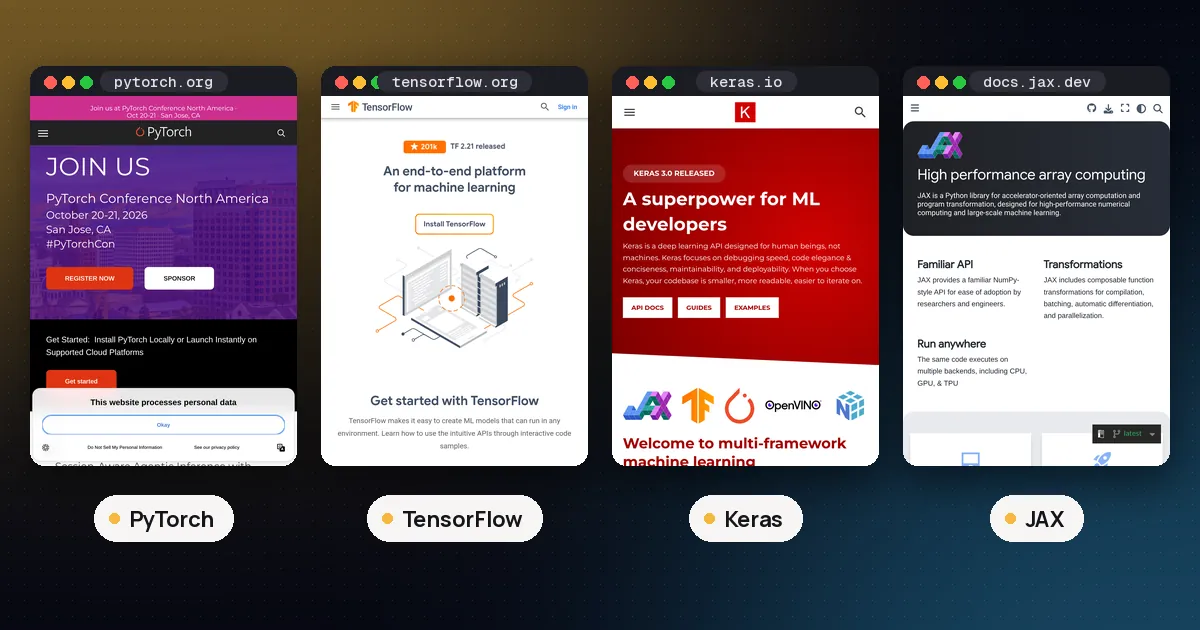
TensorFlow vs PyTorch vs Keras is easier once you stop treating them as three equal peers. PyTorch and TensorFlow are full deep learning frameworks. Keras is a high-level API that can run on top of TensorFlow, JAX, or PyTorch. For open-weight LLMs, fine-tuning stacks, and research code in 2026, pick PyTorch. Use Keras 3 when you want a concise Sequential or Functional model that can switch backends. Stay with TensorFlow (usually through Keras) when you already have TF production pipelines, TF Serving, or browser and mobile export paths that your team depends on.
TensorFlow vs PyTorch vs Keras at a glance
| Item | PyTorch | TensorFlow | Keras 3 |
|---|---|---|---|
| Latest stable (PyPI, checked October 11, 2026) | 2.14.1 (torch) | 2.21.0 | 3.15.1 |
| What it is | Full framework (eager by default) | Full framework (eager by default; graph tools for deployment) | High-level multi-backend API |
| Typical entry point | torch.nn.Module | tf.keras or low-level tf.* | import keras + KERAS_BACKEND |
| Backends / runtime | Its own runtime | Its own runtime | TensorFlow, JAX, PyTorch; OpenVINO for inference-only |
| Open-weight LLM ecosystem | Default (Transformers, fine-tuning, most servers) | Legacy / shrinking for new LLM tools | Handy for classical DL; not the main LLM path |
| Governance | PyTorch Foundation (Linux Foundation) | Google-led open-source project | Keras team; works with those backends |
| Licence | BSD-style | Apache 2.0 | Apache 2.0 |
Release numbers come from PyPI; check pytorch.org, tensorflow.org, and keras.io for newer versions.
How the three relate (and why "vs Keras" is special)
People still search tensorflow vs pytorch vs keras as if Keras were a third framework competing head-to-head. Historically, Keras sat on TensorFlow as tf.keras. TensorFlow's own guide still describes Keras as the high-level API for the TensorFlow platform and tells most TensorFlow users to start there rather than on low-level Core APIs.
That story changed with Keras 3. Per the Keras getting-started docs and the keras-team/keras README, Keras 3 is a multi-backend deep learning API: you install keras plus a backend (tensorflow, jax, or torch), set KERAS_BACKEND before importing Keras, and write one model code path that can run on any of those. OpenVINO is listed as an inference-only backend. From TensorFlow 2.16 onward, installing TensorFlow pulls in Keras 3 by default, so from tensorflow import keras is Keras 3 unless you intentionally pin the legacy tf_keras path.
So the real comparison is usually:
- PyTorch vs TensorFlow as the low-level engine and ecosystem.
- Keras vs writing raw framework code as the API style.
- Which Keras backend if you choose the high-level API.
If you are choosing between PyTorch and JAX specifically (TPUs, functional transforms, Flax), see our dedicated PyTorch vs JAX guide; that page overlaps only lightly with this three-way Keras-focused angle.
TensorFlow vs Keras: API or framework?
TensorFlow vs Keras is not a fair "pick one forever" contest. Keras is the recommended high-level surface for most TensorFlow workflows. You reach for TensorFlow Core when you are building tools on top of TensorFlow, custom high-performance platforms, or deployment paths that need graph-level control beyond what model.fit gives you.
Practical implications:
- New TF users: start with Keras Sequential or the Functional API, not with raw sessions or graph plumbing from TensorFlow 1.x memory.
- Existing
tf.kerascode: Keras 3 on the TensorFlow backend is intended as a drop-in for many models; multi-backend portability needskeras.opsinstead of scatteredtf.*calls, as covered in Keras's migration guides. - Production TF shops: you may still standardize on TensorFlow as the runtime while writing almost all model code in Keras.
TensorFlow vs PyTorch: which is easier?
For tensorflow vs pytorch which is easier, most beginners find PyTorch gentler: models are ordinary Python classes, execution is eager, and debuggers and print statements behave like the rest of Python. TensorFlow 2.x also defaults to eager execution and leans on Keras for approachability, so the gap is smaller than in the TensorFlow 1 era—but the tutorial and Stack Overflow gravity for research and open models still sits with PyTorch.
Easier also means "easier to hire for" and "easier to copy working examples." On that score, open-weight LLM repos, blog posts, and course projects skew PyTorch. Keras remains very easy for classical computer vision, tabular nets, and teaching Sequential stacks—especially in Google Colab or Kaggle notebooks—because the API hides a lot of boilerplate.
Ecosystem for open-weight models
This is where the three-way choice stops being theoretical. Hugging Face Transformers focused on PyTorch as the primary backend as Flax and TensorFlow paths were sunset in the v5 era; fine-tuning stacks covered in how to fine-tune an LLM locally, and from-scratch training walkthroughs like train a small LLM from scratch, assume PyTorch. Serving engines in the open ecosystem are largely PyTorch-based or independent C++ projects.
TensorFlow still matters for large installed bases, mobile and edge export traditions, and teams already invested in TF tooling. It is rarely the starting point for a new open-weight LLM fine-tune in 2026.
Keras 3 sits in the middle as a productivity layer: great when your model fits the Keras mental model and you might want a JAX or TensorFlow backend later. It is not a substitute for the PyTorch-native LLM tooling chain.
The PyTorch Foundation, hosted by the Linux Foundation, now frames PyTorch as part of a broader open-source AI portfolio (training, inference, and adjacent projects). That governance story reinforces why so much of the open-model stack standardizes on PyTorch.
Pros and cons
PyTorch
- Pros: default for open-weight LLMs and research; natural Python debugging; huge example surface; foundation-backed ecosystem.
- Cons: deployment story is a constellation of tools rather than one opinionated path; beginners can feel lost in the breadth of the API.
TensorFlow
- Pros: mature production and export story; Keras as the documented default high-level API; strong in organizations that already standardized on TF.
- Cons: weaker default for new open-weight LLM work; two layers (Core vs Keras) confuse newcomers who only wanted "the framework."
Keras 3
- Pros: concise Sequential / Functional / Subclassing APIs; multi-backend (TensorFlow, JAX, PyTorch); good teaching and classical DL fit; can keep model code portable.
- Cons: not the center of gravity for LLM fine-tuning and serving; custom training steps and low-level ops can force backend-specific code; you still must install and understand a backend.
Which should you choose?
- Fine-tuning or running open-weight LLMs: PyTorch.
- Learning deep learning with small CNNs, MLPs, or teaching labs: Keras 3 (often with the TensorFlow or PyTorch backend).
- Existing TensorFlow production, TF Serving, or TF-centric mobile/web export: TensorFlow, writing models in Keras.
- Want one model definition that might run on JAX later: Keras 3 with a portable
keras.opsstyle; or compare PyTorch and JAX directly in PyTorch vs JAX. - Not sure and building something new in 2026: start with PyTorch; add Keras later if you want more abstraction.
Who this is for
Students picking a first framework, engineers migrating off older TensorFlow 1 habits, and teams deciding whether "learn Keras," "standardize on PyTorch," or "keep TensorFlow in production" is the real decision.
FAQ
Is Keras the same as TensorFlow?
No. Keras is a high-level deep learning API. TensorFlow is a full framework. Keras can run on TensorFlow, and TensorFlow documents Keras as its preferred high-level API, but Keras 3 can also use JAX or PyTorch as the backend.
Should I learn TensorFlow or PyTorch in 2026?
For most people entering open-source ML and LLMs, learn PyTorch first. Learn TensorFlow if your job or coursework requires it, or if you maintain TF production systems. You can still use Keras on top of either (and on JAX).
Can Keras 3 use PyTorch as a backend?
Yes. Install torch and keras, set KERAS_BACKEND to torch before importing Keras, and run Keras workflows on PyTorch. The Keras getting-started guide lists minimum backend versions and configuration options.
Is TensorFlow dead?
No. It remains actively released and widely used in production. What changed is the default choice for new open-weight LLM projects, which has shifted strongly toward PyTorch and its ecosystem.
Which is easier for beginners: TensorFlow or PyTorch?
PyTorch usually feels more like ordinary Python. Keras (on any backend) is often the easiest API for a first Sequential model. Many beginners learn Keras concepts and PyTorch together over time.
Do I need all three?
No. Pick a primary stack. A common 2026 setup is PyTorch for LLM work, with Keras optional for classical models or teaching. Keep TensorFlow when you inherit it—not because the three-way comparison demands it.