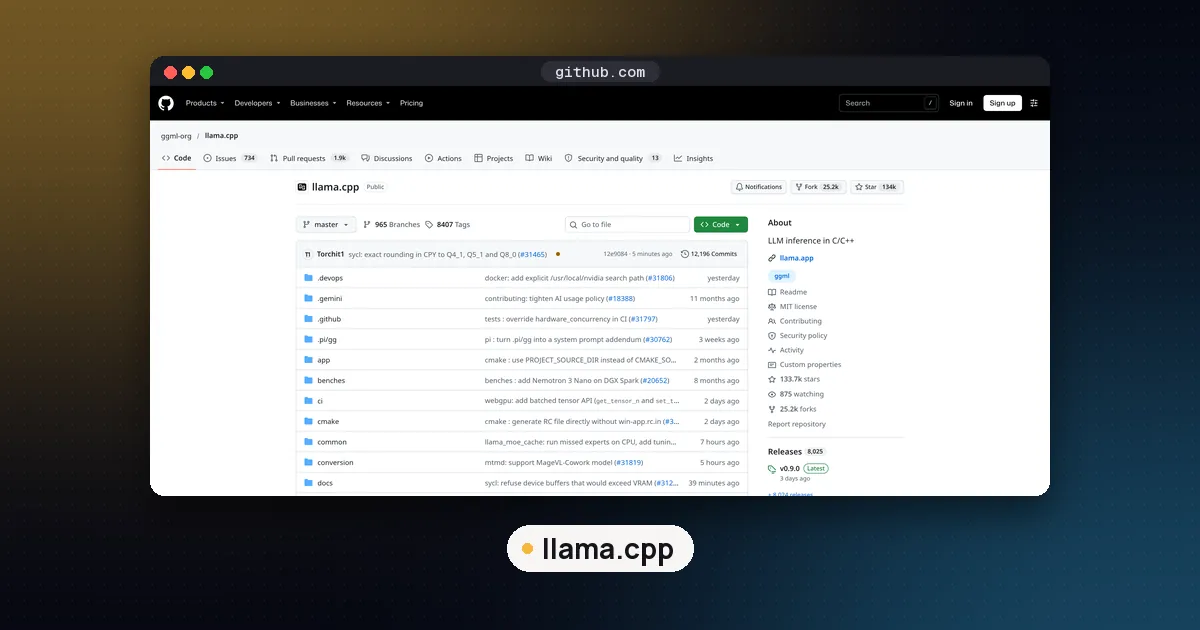
To run llama.cpp on an AMD GPU, download the prebuilt Vulkan build if you want the quickest start on any recent Radeon card, or the ROCm (HIP) build if your card is on AMD's ROCm support list and you want to test the native path. Then start llama-server or llama-cli with -ngl 99 so every layer goes to the GPU. Both backends are official parts of llama.cpp, and neither one wins on every card, so benchmark both with llama-bench before you settle.
AMD support moved fast in November 2026. An AMD tuned patch set for llama.cpp hit the Hacker News front page this week, the official releases now ship ROCm and Vulkan archives for Windows and Linux every few hours, and AMD's current ROCm release lists RDNA4, RDNA3 and Ryzen AI chips.
ROCm vs Vulkan for llama.cpp
llama.cpp talks to AMD hardware through two backends of its ggml tensor library. The HIP backend uses AMD's ROCm stack, the same code path as the CUDA backend compiled for AMD. The Vulkan backend uses the standard graphics and compute API that your normal Radeon driver already provides.
| Item | ROCm (HIP backend) | Vulkan backend |
|---|---|---|
| What you install | ROCm runtime on Linux; the Windows zip bundles the HIP runtime DLL | Just the GPU driver (Vulkan comes with it on Windows) |
| Card coverage | Cards on AMD's ROCm list, plus some others with an override on Linux | Almost any Radeon with a working Vulkan driver, plus Intel and NVIDIA |
| Download size (b12811) | about 290 MB (Linux) and 299 MB (Windows) | about 37 MB (Linux) and 39 MB (Windows) |
| Device name in llama.cpp | ROCm0, ROCm1 ... | Vulkan0, Vulkan1 ... |
| Best for | Supported RDNA3 and RDNA4 cards, Instinct accelerators, AMD tuned forks | Quick setup, older or unlisted cards, mixed vendor machines |
Sizes come from the asset list of release b12811, published Nov 27, 2026.
The short version: start with Vulkan because it takes two minutes. If you have a supported card and care about speed, install the ROCm build too and compare the numbers on your own model.
Which AMD GPUs work with llama.cpp
Vulkan works on nearly every recent Radeon whose driver exposes Vulkan compute, which current AMD drivers on Windows and Mesa's RADV driver on Linux both do.
ROCm is pickier. The ROCm 10.2.0 compatibility matrix lists these consumer and workstation parts, among others:
- RDNA4: Radeon RX 9070 XT, 9070 GRE, 9070, 9060 XT, 9060 and 9050, plus Radeon AI PRO R9700 and R9600 (gfx1200 and gfx1201)
- RDNA3: Radeon RX 7900 XTX, 7900 XT, 7900 GRE, 7800 XT, 7700 XT, 7700 and 7600, plus Radeon PRO W7900, W7800 and W7700 (gfx1100 to gfx1102)
- RDNA2: only the Radeon PRO W6800 and V620 (gfx1030)
- Ryzen APUs: Ryzen AI Max chips such as the Max+ 395 with Radeon 8060S (gfx1151), Ryzen AI 300 and 400 series (gfx1150 to gfx1153) and Radeon 780M parts (gfx1103)
- Instinct: MI100 through MI355X
Note what is missing: consumer RX 6000 cards such as the RX 6800 XT are not on AMD's list. Ollama's GPU support page still lists the RX 6800 to 6950 XT for its own Linux ROCm builds, so many of them do run. Expect less help from AMD if something breaks.
We also checked what the official prebuilt ROCm library actually contains. The libggml-hip.so file in the b12811 Linux archive carries compiled kernels for gfx908, gfx90a, gfx942 and gfx950 (Instinct), gfx1010 to gfx1012 (RDNA1), gfx1030 to gfx1036 (RDNA2), gfx1100 to gfx1103 (RDNA3), gfx1150 to gfx1152 (RDNA3.5) and gfx1200 to gfx1201 (RDNA4). So the download covers far more chips than AMD officially supports, even if the ROCm libraries underneath may not.
llama.cpp AMD GPU setup with prebuilt downloads
The fastest route is the official release archive. Each build on the releases page includes win-vulkan-x64, win-rocm-10.0-x64, ubuntu-vulkan-x64 and ubuntu-rocm-10.0-x64 files.
Windows:
- Update to a current AMD Adrenalin driver.
- Download
llama-<build>-bin-win-vulkan-x64.zip(or thewin-rocm-10.0-x64zip) and unzip it to a folder such asC:\llama. - Open a terminal in that folder and run
llama-server.exe -m C:\models\model.gguf -ngl 99. - Open
http://127.0.0.1:8080in a browser to chat.
The Windows ROCm zip ships amdhip64_7.dll and amd_comgr.dll next to the programs, so you do not install a separate HIP SDK just to run it. Ollama's docs list only the RX 7000 series and Radeon PRO W7000 cards for ROCm on Windows, which is a fair guide to where the ROCm route is most likely to work there. Everything else should use Vulkan.
Linux:
- For Vulkan, make sure
vulkaninfolists your card (installmesa-vulkan-driversor your distro's equivalent if it does not). - For ROCm, install the ROCm runtime with AMD's
amdgpu-installtool first. The Linux archive does not bundle it: itslibggml-hip.solinks againstlibamdhip64.so.7,librocblas.so.5andlibhipblas.so.3from your system. - Extract the matching
ubuntu-vulkan-x64orubuntu-rocm-10.0-x64tarball and run./llama-server -m ~/models/model.gguf -ngl 99.
If you have not used llama.cpp before, our guide on how to use llama.cpp covers downloading GGUF models from Hugging Face, chat templates and the web interface.
Docker: the Docker guide lists ghcr.io/ggml-org/llama.cpp:server-rocm and server-vulkan images. Pass the GPU through with --device /dev/kfd --device /dev/dri for ROCm or the /dev/dri render node for Vulkan. The project notes that its GPU images are built but not otherwise tested by CI.
Build llama.cpp for AMD from source
Build from source when you want the newest commit, a specific GPU target or both backends in one binary. The commands below come from the official build guide.
ROCm on Linux (example for a gfx1030 card):
HIPCXX="$(hipconfig -l)/clang" HIP_PATH="$(hipconfig -R)" \
  cmake -S . -B build -DGGML_HIP=ON -DGPU_TARGETS=gfx1030 -DCMAKE_BUILD_TYPE=Release \
  && cmake --build build --config Release -- -j 16
GPU_TARGETS is optional. Leave it out and the build compiles for every GPU in the machine. To find your target, run rocminfo | grep gfx and match it against the LLVM AMDGPU processor list. On Windows, use the x64 Native Tools prompt with -G Ninja -DGGML_HIP=ON -DGPU_TARGETS=gfx1100 and clang as the compiler, as the guide shows for an RX 7900 XTX.
Vulkan on Linux:
sudo apt-get install libvulkan-dev glslc spirv-headers
cmake -B build -DGGML_VULKAN=1
cmake --build build --config Release
On Windows the guide offers w64devkit, Git Bash with Visual Studio, or MSYS2, each with the LunarG Vulkan SDK installed.
Both at once: the build guide says you can enable several backends together (for example -DGGML_HIP=ON -DGGML_VULKAN=ON) and pick one at run time with --device. That is the easiest way to compare them on the same machine.
Check that llama.cpp is using your AMD GPU
Run llama-cli --list-devices. You should see entries such as ROCm0 or Vulkan0 with your card's name and free memory. At startup the Vulkan backend also prints a ggml_vulkan: Using ... line naming the GPU.
Three settings matter most:
-ngl 99offloads all layers. If the model does not fit in VRAM, lower it or keep the mixture of experts layers in system memory with--n-cpu-moe. Our guide on whether a local LLM can use RAM instead of VRAM explains that tradeoff, and how much VRAM you need for an LLM helps you pick a quant that fits.--device ROCm0or--device Vulkan0chooses the backend when you built both, or skips an integrated GPU.HIP_VISIBLE_DEVICES(ROCm) andGGML_VK_VISIBLE_DEVICES(Vulkan) hide cards you do not want used, which helps on laptops with both an integrated and a discrete Radeon.
Running llama.cpp on older or unsupported Radeon cards
If ROCm refuses your card, you have two options.
Override the GPU version (Linux only). The build guide says you can set HSA_OVERRIDE_GFX_VERSION to a similar supported chip, for example 10.3.0 for RDNA2 parts such as gfx1031 or gfx1035, or 11.0.0 for RDNA3. Ollama's docs give the same trick for an RX 5400 (gfx1034), and add that machines with two different cards can use HSA_OVERRIDE_GFX_VERSION_0 and _1. The override is not supported on Windows.
Switch to Vulkan. Vulkan does not care whether AMD lists your card for ROCm. For many RX 5000 and RX 6000 owners, and for integrated graphics, it is the path with the fewest surprises.
How to benchmark ROCm vs Vulkan on your card
Speed depends on the card, the driver version, the model architecture and the quant, so we will not hand you a universal winner. The bundled llama-bench tool settles it for your own setup. With a build that has both backends:
./llama-bench -m model.gguf -ngl 99 -dev ROCm0,Vulkan0 -fa on,offllama-bench runs every combination of comma separated values and prints prompt processing (pp) and text generation (tg) speeds in tokens per second. Prompt processing matters for long documents; text generation is how fast answers appear. Add -d 8192 to test at a deeper context, since speeds shift as the context fills, and rerun after driver or llama.cpp updates.
AMD tuned llama.cpp forks
The project behind this week's Hacker News thread is llama-cpp-rdna-boosts, an MIT licensed set of patches applied on top of a pinned llama.cpp commit. Its README describes 18 official blocks for RDNA3, RDNA3.5 and RDNA4 (RDNA2 is best effort) with work on WMMA flash attention, fused mixture of experts decode, chunked gated delta net prefill and lower attention memory, all on by default.
In the blog post behind the thread, one user with a Radeon AI PRO R9700 reports prefill rising from about 700 to about 1,300 tokens per second and generation from about 35 to about 55 after switching, on a Qwen 3.8 27B GGUF. That is one person's measurement on one card, not a benchmark we ran.
Pros: real speedups on supported RDNA cards, a small and documented patch set, prebuilt container images.
Cons: it trails upstream (it rebases to a fixed commit), so brand new model support may arrive late; RDNA2 gets no performance claims; and the blog's author warns that some other AMD focused engines gain speed by changing which experts a model uses, which can hurt output quality. Check outputs, not just tokens per second.
Ollama, LM Studio and other AMD options
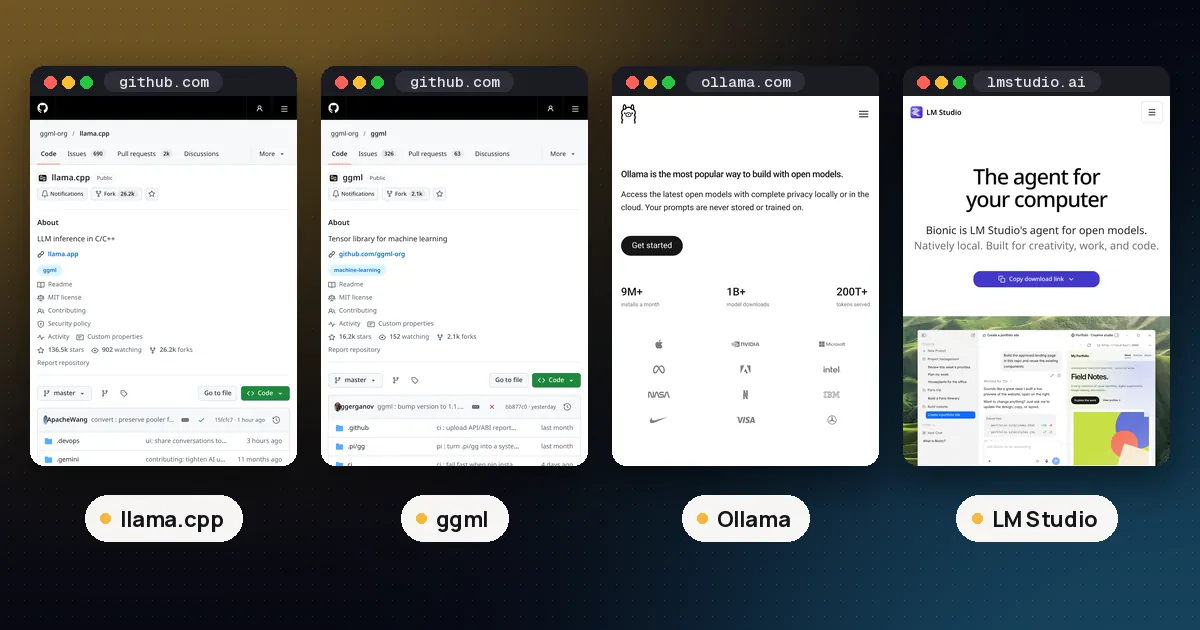
If you would rather not manage llama.cpp builds, Ollama runs on AMD through ROCm (v7 drivers on Linux and Windows) and turns on Vulkan by default for cards ROCm skips. LM Studio also runs GGUF models through llama.cpp, and AMD's own Lemonade server targets Ryzen AI and Radeon PCs; our list of LM Studio alternatives for Windows compares them. For serving many users at once on Instinct cards, vLLM has ROCm builds; see vLLM vs llama.cpp for when that makes sense.
Who should use llama.cpp on an AMD GPU
Choose plain llama.cpp with Vulkan if you own any recent Radeon, want local models running tonight and do not want to install ROCm. Choose the ROCm build if you have a supported RX 7000 or RX 9000 card, a Radeon AI PRO or a Ryzen AI Max machine and you are willing to benchmark. Try an AMD tuned fork only after you have numbers from upstream to compare against.
FAQ
Is Vulkan or ROCm faster for llama.cpp?
It depends on the card, model and driver, and the answer can change between releases. Build or download both, then run llama-bench with -dev ROCm0,Vulkan0 on the model you actually use and compare prompt processing and generation speeds.
Can llama.cpp use an AMD GPU on Windows?
Yes. The official releases include a Vulkan zip that works with the normal Radeon driver and a ROCm zip that bundles the HIP runtime DLL. Vulkan is the safer choice for cards outside the RX 7000 and Radeon PRO W7000 range.
Does llama.cpp support the RX 6800 XT or RX 6700 XT?
Through Vulkan, yes. For ROCm, AMD's 10.2.0 matrix does not list consumer RX 6000 cards, but the prebuilt llama.cpp library includes kernels for gfx1030 to gfx1036, and on Linux you can set HSA_OVERRIDE_GFX_VERSION=10.3.0 for chips such as gfx1031.
What does HSA_OVERRIDE_GFX_VERSION do?
It tells the ROCm runtime to treat your GPU as a similar supported chip, so ROCm libraries load kernels built for that chip. It is a Linux workaround with no guarantee, and it does not work on Windows.
Do I need to install ROCm to use llama.cpp on an AMD GPU?
Not for Vulkan, which only needs your graphics driver. On Linux the ROCm archive expects AMD's runtime libraries (libamdhip64, rocBLAS and hipBLAS) to be installed already. On Windows the ROCm zip ships the HIP runtime DLL with it.
Can llama.cpp use a Ryzen AI Max+ 395 or Radeon 780M?
Yes. AMD's ROCm matrix lists the Ryzen AI Max+ 395 (gfx1151) and Radeon 780M (gfx1103), and the prebuilt ROCm library includes kernels for both. Vulkan works on them as well. Because these chips share system memory, the model size you can load depends on how much RAM is assigned to graphics.