In the SmolLM vs Llama choice, SmolLM3 is the better pick for most new projects at the 3B size. On Hugging Face's own evaluation tables it beats Llama 3.2 3B on maths, coding, reasoning and multilingual knowledge, it adds a switchable reasoning mode, and it ships under Apache 2.0 with its full training recipe. Pick Llama 3.2 (1B or 3B) when you need better recall across very long contexts, official support in Meta's ExecuTorch and Llama Stack tooling, or a model your team has already tuned and tested.
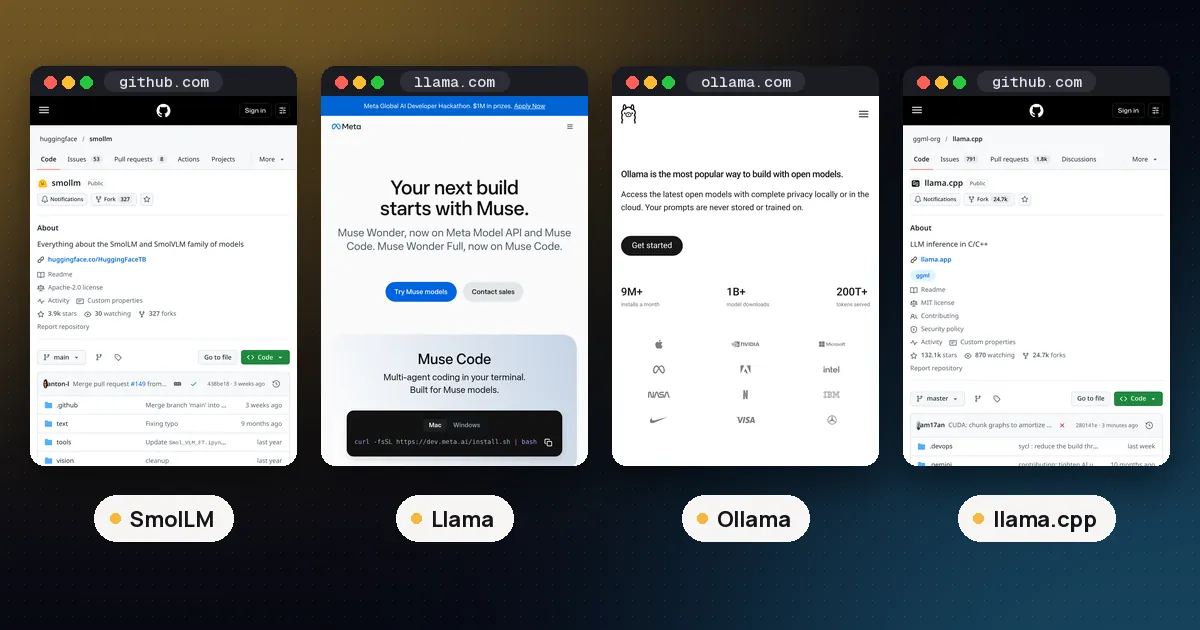
The two families come from different places. Llama 3.2 is Meta's small model release from September 2024, distilled from the larger Llama 3.1 models. SmolLM is Hugging Face's research line, built to show in public how a small model is trained. Below we compare SmolLM3 and SmolLM2 against Llama 3.2 1B and 3B on quality, licence, memory and setup, and explain where Meta's newer models fit.
SmolLM vs Llama at a glance
Every figure here comes from the official model cards and library pages linked in the sections below.
| Item | SmolLM3-3B | SmolLM2 | Llama 3.2 3B | Llama 3.2 1B |
|---|---|---|---|---|
| Maker | Hugging Face | Hugging Face | Meta | Meta |
| Parameters | 3.08B | 135M, 360M, 1.7B | 3.21B | 1.23B |
| Licence | Apache 2.0 | Apache 2.0 | Llama 3.2 Community License | Llama 3.2 Community License |
| Context | 64K native, 128K with YaRN | 8K (16K variant for 1.7B) | 128K | 128K |
| Pretraining tokens | 11.2 trillion | Up to 11 trillion (1.7B) | Up to 9 trillion | Up to 9 trillion |
| Languages | 6 main languages | Mainly English | 8 officially supported | 8 officially supported |
| Reasoning mode | Yes, /think and /no_think | No | No | No |
| Download gated | No | No | Yes, accept licence on Hugging Face | Yes |
What SmolLM is
SmolLM is Hugging Face's family of small open models. According to the SmolLM3-3B model card, SmolLM3, published in July 2025, is a 3B decoder transformer with grouped query attention and NoPE (some layers drop rotary position embeddings), pretrained on 11.2 trillion tokens of web, code, maths and reasoning data in stages, then given 140 billion tokens of reasoning midtraining, supervised fine tuning and preference alignment. It was trained at 64K context and stretches to 128K with YaRN.
The card calls it a fully open model: open weights plus the public data mixture, training configs and intermediate checkpoints. Pretraining used Hugging Face's nanotron framework and post training used TRL. If you care about how small models get built, our guides on training a small LLM from scratch and the best LLM pretraining datasets cover the same public corpora.
SmolLM2 is the smaller, older line with 135M, 360M and 1.7B sizes. It is the family to compare against Llama 3.2 1B when memory is very tight, and the SmolLM2 1.7B Instruct card does exactly that: the 1.7B instruct model scores 56.7 on IFEval and 48.2 on GSM8K (5 shot), against 53.5 and 26.8 for Llama 3.2 1B Instruct in Hugging Face's runs. SmolLM2 is trained mainly on English, so Llama 3.2 1B is the safer small choice for its other supported languages.
What Llama 3.2 is
Llama 3.2 is Meta's lightweight text release. The Llama 3.2 1B Instruct model card lists 1.23B and 3.21B parameter models, both with 128K context, pretrained on up to 9 trillion tokens with a December 2023 knowledge cutoff. Meta built them by pruning and then distilling from Llama 3.1 8B and 70B, using the larger models' logits as training targets. English, German, French, Italian, Portuguese, Hindi, Spanish and Thai are the officially supported languages.
Meta also released quantized versions built for phones. The card describes SpinQuant and QLoRA variants designed for the ExecuTorch runtime on Arm CPUs, with an 8K context. On a OnePlus 12, Meta measured the 1B SpinQuant build at 50.2 tokens per second for decoding, against 19.2 for the BF16 baseline. That mobile work is the strongest practical reason to choose Llama 3.2 today.
SmolLM3 vs Llama 3.2: quality
This is one of the rare comparisons with a fair table. Hugging Face ran SmolLM3 and Llama's 3B models through the same lighteval harness and published the results on the SmolLM3 card, so the numbers below share settings. They are still the SmolLM team's numbers, not an independent test.
Instruct models, no thinking mode (SmolLM3 card; the Llama column is labelled "Llama3.1-3B" there, though Meta's only 3B instruct model is Llama 3.2):
| Benchmark | SmolLM3-3B | Llama 3B instruct |
|---|---|---|
| AIME 2025 | 9.3 | 0.3 |
| GSM-Plus | 72.8 | 59.2 |
| LiveCodeBench v4 | 15.2 | 3.4 |
| GPQA Diamond | 35.7 | 29.4 |
| IFEval | 76.7 | 71.6 |
| Global MMLU | 53.5 | 46.8 |
Base models (same card, Llama 3.2 3B base):
| Benchmark | SmolLM3-3B base | Llama 3.2 3B base |
|---|---|---|
| MATH (4 shot) | 46.10 | 7.44 |
| GSM8k (5 shot) | 67.63 | 25.92 |
| HumanEval+ | 30.48 | 25.00 |
| CommonsenseQA | 55.28 | 60.60 |
| Ruler 64k | 67.85 | 72.93 |
| Ruler 128k | 61.03 | 71.30 |
Two things stand out. SmolLM3 is far ahead on maths and code, and its reasoning mode lifts it further (the card reports 36.7 on AIME 2025 with thinking on). Llama 3.2 3B keeps a real lead on long context retrieval at 64K and 128K, plus a small edge on some commonsense tests. If your app stuffs whole documents into the prompt and asks for one fact back, test Llama 3.2 before you switch.
The SmolLM GitHub repository sums up Hugging Face's position: SmolLM3 "outperforms Llama 3.2 3B and Qwen2.5 3B". Our read of the tables agrees for maths, code and multilingual work, with the long context exception above.
Licence: Apache 2.0 vs the Llama Community License
This difference matters more than any benchmark for a product team. SmolLM3 and SmolLM2 use plain Apache 2.0, so you can ship, modify and rename them with the usual notice.
The Llama 3.2 Community License, shown on the same Hugging Face card, adds conditions. If you distribute the model or a product built on it, you must show "Built with Llama". A model you train or fine tune using Llama materials or outputs and then distribute must have "Llama" at the start of its name. Companies with more than 700 million monthly active users must ask Meta for a separate licence, and use must follow Meta's acceptable use policy. Downloads on Hugging Face are gated behind accepting these terms. For the wider picture, see open weight vs open source.
Memory: SmolLM vs Llama on a laptop
All four models fit easily on an 8 GB machine. File sizes below come from the Ollama library and the ggml-org GGUF repo; longer contexts add KV cache on top (see how much VRAM you need for an LLM).
| Model | 4 bit download | 8 bit | 16 bit | Source |
|---|---|---|---|---|
| SmolLM3-3B | 1.92 GB (Q4_K_M) | 3.28 GB (Q8_0) | 6.16 GB (F16) | ggml-org GGUF |
| Llama 3.2 3B | 2.0 GB (Q4_K_M) | 3.4 GB | 6.4 GB | Ollama llama3.2 tags |
| Llama 3.2 1B | 808 MB (Q4_K_M) | 1.3 GB | 2.5 GB | Ollama llama3.2 tags |
| SmolLM2 1.7B | 1.8 GB | Ollama smollm2 tags | ||
| SmolLM2 135M / 360M | 271 MB / 726 MB | Ollama smollm2 tags |
Note that Ollama's default llama3.2:1b tag is the 8 bit build (1.3 GB), while the default llama3.2 tag is the 3B at Q4_K_M. If the quant names are new to you, read GGUF quantization explained.
How to run each one locally
Llama 3.2 and SmolLM2 have official Ollama tags. SmolLM3 has no official Ollama library entry, but Ollama can pull any GGUF repo from Hugging Face directly:
# Llama 3.2
ollama run llama3.2        # 3B, Q4_K_M
ollama run llama3.2:1b

# SmolLM
ollama run hf.co/ggml-org/SmolLM3-3B-GGUF:Q4_K_M
ollama run smollm2:1.7b
The same GGUF files work in llama.cpp with llama-server. On a Mac, mlx-lm loads MLX builds of both families. In Transformers, the Llama 3.2 card asks for version 4.43.0 or later, and SmolLM3 needs 4.53.0 or later. For serving, the SmolLM3 card documents a vLLM command with tool calling switched on, and Llama 3.2 is supported in vLLM as well.
Not sure which runner to use? See Ollama vs llama.cpp vs LM Studio.
SmolLM3's reasoning switch
SmolLM3 thinks before answering by default. Add /no_think to the system prompt, or pass enable_thinking=False to the chat template, for short direct replies. Hugging Face suggests temperature 0.6 and top_p 0.95. Llama 3.2 has no separate thinking mode, so it answers directly every time.
Fine tuning SmolLM vs Llama
Both are small enough to fine tune with LoRA on one consumer GPU, and both load through Transformers, so TRL and PEFT work with either. Unsloth is another popular route for Llama models. Our guide to fine tuning an LLM locally works for either, and LoRA vs QLoRA covers the memory tradeoff.
Two differences matter. Llama 3.2 has a large set of community fine tunes to start from (the 1B Instruct card alone lists more than 1,800). SmolLM3 gives you base checkpoints from each training stage plus the data recipe, so you can continue pretraining or rerun ablations. Remember the naming rule above if you publish a Llama fine tune.
What about newer Meta models?
Llama 3.2's 1B and 3B are still the smallest models on Meta's Llama 3 models page. Llama 4 Scout and Maverick (April 2025) are mixture of experts models with 109B and 400B total parameters, according to the Llama 4 Scout model card, so they are not laptop alternatives. Meta's newer open models carry the Muse name: Muse Glimmer, released August 10, 2026 under Apache 2.0, is a 30B model aimed at 24 to 32 GB GPUs, and our guide to running Muse Spark Open locally covers the big one. Neither competes with SmolLM at the 1B to 3B size.
Which should you use?
- General small assistant, maths or code helper: SmolLM3. It scores higher on the shared tables and has a reasoning mode.
- Long document question answering at 64K to 128K: Llama 3.2 3B, based on its Ruler scores.
- Android or iOS app on ExecuTorch: Llama 3.2 1B or 3B SpinQuant builds, which Meta tuned and measured for phones.
- Tiny models under 1 GB: SmolLM2 135M or 360M, or Llama 3.2 1B at 4 bit.
- Research you need to reproduce: SmolLM3, the only one here with open data and configs.
- No licence paperwork: SmolLM, under Apache 2.0.
If you are also weighing Google's small models, read our SmolLM vs Gemma comparison, and for a wider shortlist see open source LLM models to run locally.
FAQ
Is SmolLM3 better than Llama 3.2 3B?
On Hugging Face's shared evaluation tables, yes for maths, coding, reasoning and multilingual knowledge. Llama 3.2 3B scores higher on long context retrieval at 64K and 128K tokens and on CommonsenseQA, so test both if long documents are your main use.
Is SmolLM based on Llama?
SmolLM3 uses its own design (grouped query attention, with rotary position embeddings removed from some layers) and was trained from scratch by Hugging Face on public data. It is not a Llama fine tune, and its Apache 2.0 licence carries none of the Llama naming rules.
Can I use Llama 3.2 commercially?
Yes, under the Llama 3.2 Community License. You must display "Built with Llama", follow the acceptable use policy, and request a separate licence if your products had more than 700 million monthly active users on the release date.
Which is smaller, SmolLM2 or Llama 3.2 1B?
SmolLM2 135M is far smaller, with a 271 MB Ollama download. Llama 3.2 1B is 808 MB at Q4_K_M and 1.3 GB at 8 bit, closer to SmolLM2 1.7B at 1.8 GB.
Does SmolLM3 work in Ollama?
Yes, through Hugging Face's GGUF support: ollama run hf.co/ggml-org/SmolLM3-3B-GGUF:Q4_K_M. There is no official smollm3 tag in the Ollama library, only smollm2.
Which has the longer context window?
Llama 3.2 supports 128K natively. SmolLM3 was trained at 64K and reaches 128K with YaRN extrapolation, and on the SmolLM3 card's Ruler test Llama 3.2 3B holds up better at those lengths.